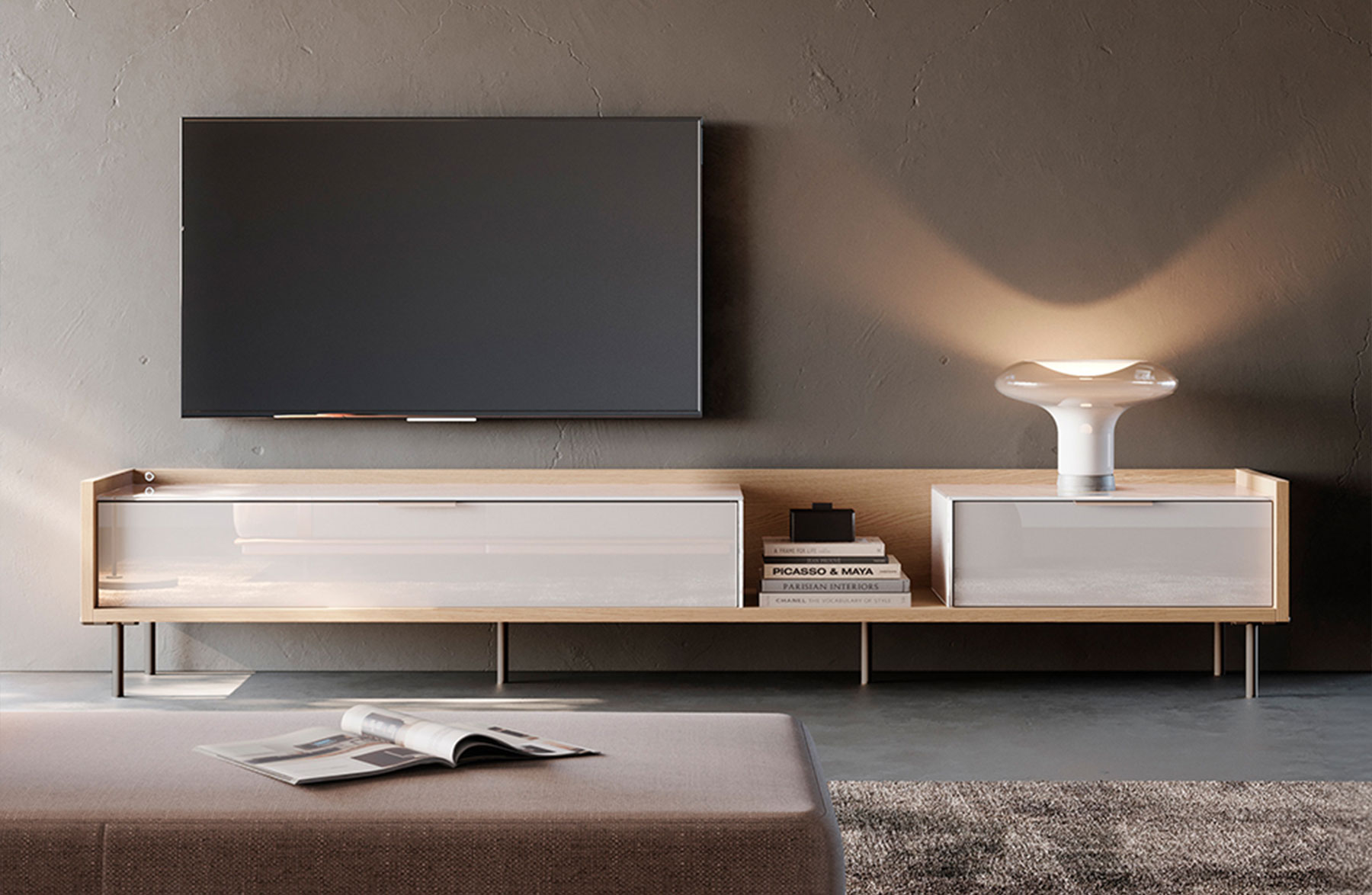
Go into the living room and look at it with different eyes for a minute.
Don’t look at the TV. Look at the cabinet under the TV.
Many people only discover they’ve made the wrong choice after a few months. At first, everything seems fine: the TV is on the top shelf, the living room is tidy. Then the warning signs appear.
1. The furniture moves when you touch it
It’s not an aesthetic problem, it’s a structural one.
A 65″ TV weighs on average 25-30 kg. A 75″ one exceeds 35 kg.
A poorly designed piece of furniture under that weight will sag over time: the wheels warp, the base becomes uneven, and the joints loosen.
Decoders, consoles, soundbars, streaming boxes, routers: today’s average home has many more connected devices than it did ten years ago.
If the unit doesn’t include internal cable routing, storage compartments, or a built-in power strip, clutter is already part of the design.
3. The soundbar covers the screen
Modern soundbars are between 7 and 10 cm tall. If the cabinet surface isn’t designed to accommodate them properly, they end up covering the bottom of the screen.
4. The TV is wider than the cabinet
A 65″ TV is about 145 cm wide. A 75″ TV is over 166 cm.
When the TV protrudes laterally from the cabinet, the visual effect is immediate: the screen appears to be resting on something temporary.
5. Devices overheat
Latest-generation consoles, decoders, and amplifiers produce heat.
A closed, unventilated cabinet turns the technical space into an oven.
The point isn’t to buy a TV stand. The point is to choose a cabinet designed for the technology it contains—now and in three years.
Munari furniture is designed with integrated cable management, including a power strip, ventilation grilles, and structures designed for the actual load capacity of today’s TVs.