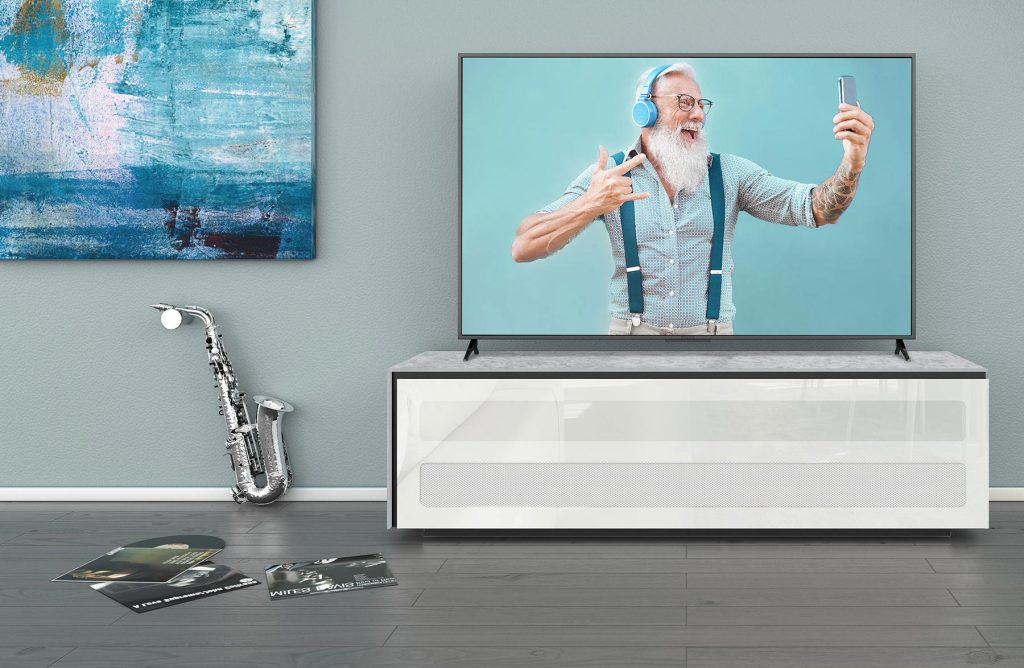
You’ve chosen the perfect TV stand. The right size, impeccable aesthetics, a color that matches the living room. Today, everything works: the 55″ TV, the cable box, maybe a soundbar. Clean, tidy, done. Then two years pass.
You added a console to play with the kids. An Apple TV because Netflix on the cable box was crap. A small NAS for family photos. You replaced the soundbar with a more powerful one. DVB-T2 forced you to upgrade your cable box. Now you have six devices instead of two, a jungle of cables coming out of everywhere, and the once-“perfect” stand has become a problem. It’s not your fault.
It’s just that no one ever told you something simple: technology in the living room evolves much faster than the furniture that contains it.
Living is no longer what it was ten years ago
In 2015, all you needed was a TV and a Sky decoder. The end. Today, your living room has become a small domestic data center without you even realizing it.
The TV is no longer just a TV: it’s the hub of your smart home, controlling the lights, suggesting what to watch with artificial intelligence, and responding to voice commands. Devices that didn’t even exist ten years ago gravitate around the TV: streaming boxes, voice assistants, next-generation consoles that heat up like radiators, NAS for storage, amplifiers for audio, HDMI switches to manage everything.
And then there are the updates that no one tells you about. DVB-T2, which has made millions of decoders obsolete. HDMI 2.1, required for 4K gaming at 120Hz. TVs that in a year will have next-generation OLED panels with double the brightness. The growing smart home: thermostats, cameras, lights, everything talks to everything.
The result? Every two years, you have a new device to plug in somewhere. And the piece of furniture you bought thinking “it’s fine like this” suddenly becomes too small, too closed, impossible to manage without dismantling everything.
The mistakes everyone makes (and no one talks about)
Mistake 1: Buying for today, not tomorrow
Most people choose a TV stand based on what they have now. TV, cable box, maybe a soundbar. Okay, it all fits. Perfect.
But in two years? When you add the console. When you replace the cable box. When you need an HDMI switch because your TV runs out of inputs. When that little amplifier becomes indispensable.
The “good” stand becomes an inadequate container. And you’re left improvising: cables sticking out, devices stacked on top, multiple sockets hanging loose, zero ventilation. The order you’d achieved turns into chaos, and every change is a war.
Mistake 2: Choosing only for aesthetics
Mistake 3: "I'll make do later"
It’s the most common mistake. “If I need space, I’ll cut a hole for the cables.” “If I add a device, I’ll put it on top.” “If it gets too hot, I’ll open the door.”
Improvisation works up to a point. Then it becomes a matter of time, of constant interventions, of temporary solutions that become permanent and ruin the aesthetics, functionality, and ultimately even the lifespan of the devices themselves.
No one tells you that that overheating cable box locked in an unventilated cabinet will have a half-life. That those haphazardly tangled cables will generate interference. That that power strip hidden in the back will be unreachable when needed.
What does "future-ready mobile" really mean?
It’s not a buzzword. It’s a concrete design approach.
A piece of furniture designed to last over technological time must have four non-negotiable characteristics:
- Room for growth
Not compartments sized for what you have, but for what you’ll have. Adequate depths (minimum 30-35cm, not 25cm), heights that allow for stacking, and widths designed for standard market devices. If you have two devices today, the cabinet must be able to easily accommodate five. Because in two years, you’ll have five. - Flexible cable management
Cable routing is pre-arranged, not improvised. Integrated power strips, not added after the fact. Strategic slots allow you to add connections without dismantling the furniture. Cable management isn’t a detail: it’s what distinguishes a professional system from a haphazard jumble. - Real ventilation
Modern devices heat up. Consoles, amplifiers, NAS, 4K decoders: they all generate heat. A closed cabinet without ventilation is a box that accelerates the obsolescence of your devices. Vents are useful. Rear vents are useful. Air circulation is essential. It’s not optional. - Accessibility for maintenance
You need to be able to service your system without disassembling everything. Changing a cable, moving a device, adding a power supply: these operations should take five minutes, not an hour with screwdrivers and frustration.
The Munari approach:
think about function, not just aesthetics
When we designed our furniture, we started from a simple observation: living room technology is constantly evolving, but furniture isn’t. You buy a piece of furniture and it should last 10-15 years. The devices you put in it change every 2-3 years.
From here, four technical solutions were born that we have integrated into our projects.
- Active Door: a special glass that lets infrared signals through. Close the door for visual control, but you can use all your remote controls without opening it. The technology is there, but it’s invisible. When you add a new device, you don’t have to keep the doors wide open.
- Acoustic fabric: For those who want a hidden soundbar or audio system. The sound comes through without distortion, while the devices remain protected and organized. When you replace the soundbar in three years, you don’t have to redesign the cabinet.
- Integrated technical preparation: internal power strip, thoughtful cable routing, and ventilation. No later additions, just an initial design. When you expand the system, everything is ready.
- Accessible Maintenance (FMS): The cabinets slide forward thanks to special brackets. Need to change a cable? Add a device? Check the wiring? Five minutes, without removing anything from the wall.
They’re not gadgets. They’re concrete answers to problems that arise when technology changes and mobile devices remain stagnant. We’ve seen too many customers return to the store after two years because “the mobile device no longer works.” Mobile devices worked perfectly well: they simply weren’t designed to evolve.
The TV stand is an investment, not an expense
A TV stand is expensive. If you choose well, you’ll use it for 10-15 years. If you choose poorly, in three years it’ll be inadequate and you’ll have to replace it or live with it uneasily.
The difference between expense and investment lies precisely here: are you buying for your living space today or for the next ten years?
In five years, TV standards will be different. Streaming boxes will be more powerful. The smart home will be the norm, not the exception. Devices will increase, not decrease. Resolutions will rise, energy consumption will rise, and management will become more complex.
The furniture you choose today must be able to accommodate all of this. Not by intuition, but by design. Not by chance, but by conscious choice.
Choosing “technical” furniture doesn’t mean sacrificing design. It means choosing furniture where design works alongside function, not against it. Where aesthetics are the result of thought, not the negation of technology.
Questions to ask yourself
before buying
When designing our furniture, before choosing any TV stand, stop and answer these questions. If even one question is unclear, think again:
- How much space do I have for new devices? If you have two devices today, does the cabinet hold at least five?
- Can I add a cable without taking everything apart? Are the cable glands accessible and flexible?
- Is ventilation real or symbolic? Is there air circulation or is it a closed compartment?
- If I change my soundbar or amplifier in two years, what happens? Do I have to redo half the furniture or is it enough to replace it?
- Can I use remote controls with the cabinet closed? Should I keep the doors open for convenience?
- If I add a console or NAS, where do they go? Is there space planned or do I have to improvise?
Bottom line: Don't buy for 2026, buy for 2036
The furniture market sells you “beautiful” furniture. The electronics market sells you “new” devices. But no one tells you that these two worlds must coexist for years, and that one changes much faster than the other.
Technology moves forward. Furniture remains. If the piece isn’t designed to accommodate this pace, it soon becomes a brake rather than a solution.
Choosing a TV stand isn’t choosing a cabinet for the TV you have now. It’s choosing the infrastructure of your living room for the next ten years. And it’s the only furniture choice you should make with your home not in mind today, but tomorrow.
Because technology changes. Furniture doesn’t. And if the piece isn’t ready, you’ll be the one to pay the consequences. With time, with adjustments, with compromises you shouldn’t have made.
Want to find out how we design furniture for the living room of the future? Explore Munari solutions and discover an approach that puts function at the service of design, not the other way around.